


Dental extraction forceps are among the most important instruments in any dental clinic or oral surgery set. Each pattern is shaped to match the crown and root anatomy of a particular tooth, so choosing the correct forceps makes extractions faster, safer and less traumatic for the patient. This guide explains the main types, how to tell upper from lower forceps, and the patterns most dentists keep in their kit.
Parts of an extraction forceps
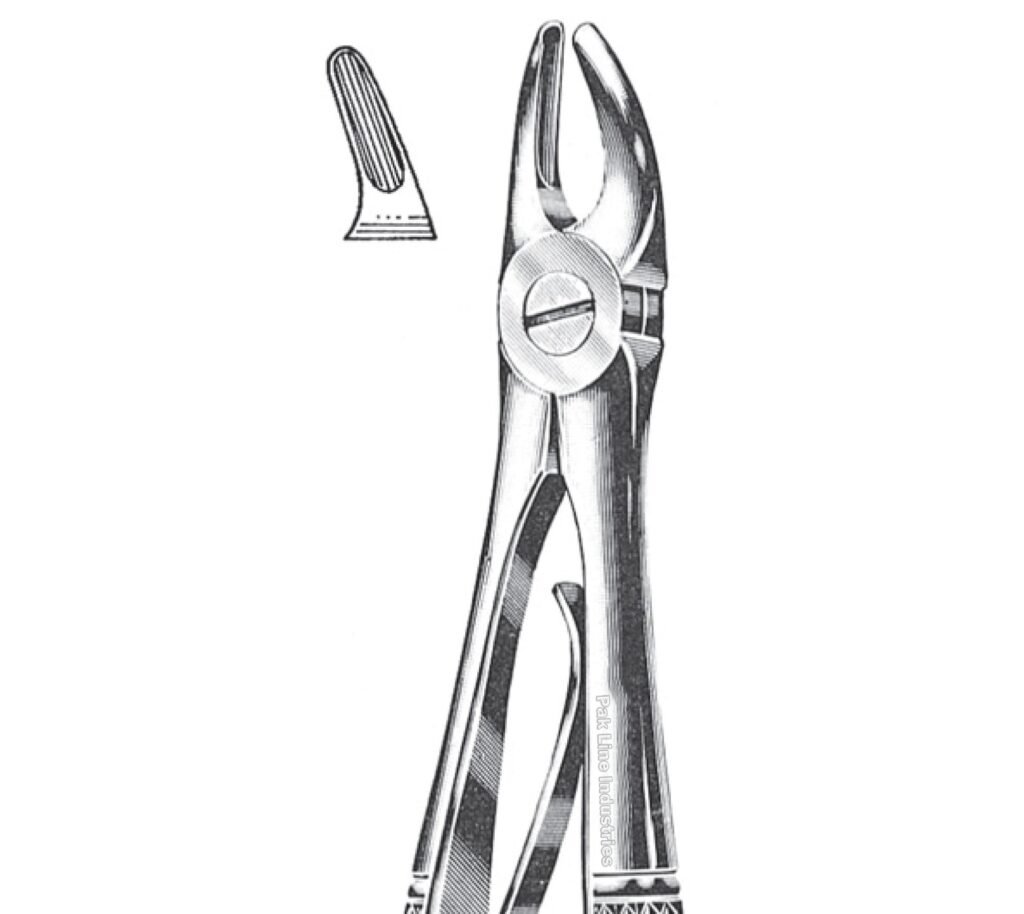
- Beaks: the working tips that grip the tooth at the cementoenamel junction. Their shape matches specific teeth.
- Hinge (joint): connects the beaks and handles. It must move smoothly with no play.
- Handles: provide grip and leverage, often serrated for a non-slip hold.
Upper vs lower forceps: how to tell them apart
- Maxillary (upper) forceps are usually straight or have a gentle S-shaped or bayonet bend, with beaks roughly in line with the handles.
- Mandibular (lower) forceps have beaks bent at roughly a right angle to the handles so the dentist can approach lower teeth from above.
English pattern vs American pattern
English pattern forceps have a vertical hinge and are held with the handles in line with the arm, which gives strong control, particularly for lower molars. American pattern forceps have a horizontal hinge and are held in the palm, offering comfort and versatility. Both are widely used and many clinics stock a mix.
Common forceps patterns and their uses
- Upper incisors and canines: straight forceps such as No. 1 / No. 99A.
- Upper premolars: S-shaped forceps such as No. 150 (universal upper) or No. 29.
- Upper molars: right and left patterns with a pointed buccal beak for the bifurcation, such as No. 18L / 18R or No. 53L / 53R.
- Upper third molars: bayonet forceps such as No. 210.
- Upper roots: slim bayonet root forceps such as No. 65 or No. 286.
- Lower incisors and premolars: No. 151 (universal lower) or No. 13.
- Lower molars: No. 17 or No. 16 “cowhorn” forceps for multi-rooted teeth.
- Lower roots: narrow root forceps such as No. 74.
- Paediatric: smaller children’s forceps, sometimes with a spring to open the handles.
Pattern numbers vary slightly between countries and catalogues, so always confirm the exact beak shape when ordering.
Forceps vs elevators and luxators
Forceps are rarely used alone. Elevators (such as Coupland, Cryer and Warwick James) and thin-bladed luxators are used first to sever the periodontal ligament and loosen the tooth, which reduces the force needed and lowers the risk of fracture. A complete extraction kit therefore combines forceps, elevators, luxators and root tip picks.
What makes good quality extraction forceps
- Surgical-grade stainless steel correctly hardened, so beaks do not bend or chip.
- Accurately shaped, finely serrated beaks that grip without slipping or crushing the crown.
- A tight, smooth joint with no wobble after hundreds of autoclave cycles.
- Balanced handles with ergonomic serrations for control.
- Corrosion resistance from proper passivation.
Caring for extraction forceps
Clean instruments promptly after use, open the joint during ultrasonic cleaning and sterilisation, lubricate hinges with instrument milk and inspect beaks regularly. See our full instrument care and maintenance guide.
Buy dental extraction forceps from the manufacturer
Pak Line Industries manufactures English and American pattern extraction forceps, children’s forceps, elevators and luxators in Sialkot, Pakistan, for dentists, dental schools and distributors. Browse our dental instruments or the dental instruments manufacturer page. Private label and custom patterns are available.
FAQs
Which forceps is used for upper molars?
Upper molars are typically extracted with right and left molar forceps such as No. 18R and 18L or 53R and 53L, which have a pointed beak for the buccal bifurcation.
What is the universal forceps for the lower jaw?
No. 151 is commonly called the lower universal forceps and is used for lower incisors, canines and premolars.
Source instruments direct from the manufacturer
Pak Line Industries has manufactured surgical, dental and beauty instruments in Sialkot, Pakistan since 1985. ISO 13485 & CE quality, OEM and private label, exported to 55 countries.
