

Scalpels and scissors get most of the attention, but three other instrument families decide whether an operation runs smoothly: retractors that hold the wound open, clamps that control bleeding and secure tissue, and rongeurs that bite away bone. For hospital suppliers, distributors and private-label brands, these are also among the most technically demanding instruments to source, because hinges, ratchets, springs and cutting jaws all have to work perfectly. This guide explains the main types, their uses and what to check before you buy.
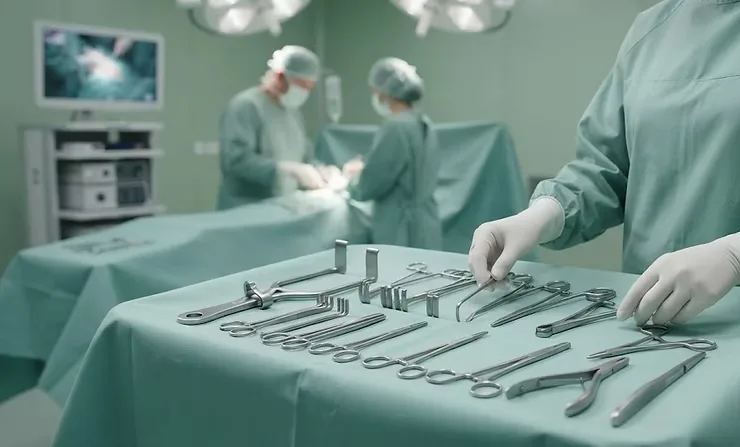
Surgical retractors: keeping the field open
Retractors hold back skin, muscle and organs so the surgeon can see and reach the operative site. They fall into two groups:
- Hand-held retractors are held by an assistant. Examples: Senn (double-ended, for small incisions), Army-Navy, Langenbeck, Czerny, Richardson, Deaver (curved, for deep abdominal work) and Hohmann retractors, which lever soft tissue away from bone in orthopaedics.
- Self-retaining retractors lock open on their own, freeing the assistant’s hands. Examples: Weitlaner and Gelpi for superficial and orthopaedic wounds, Balfour for laparotomy, and Finochietto rib spreaders for chest surgery.
What to check: correct blade depth and width, smooth ratchet or locking action on self-retaining models, sharp or blunt prongs as specified, and a satin anti-glare finish. Read our full guide to surgical retractor types and names or browse retractors and spreaders.
Surgical clamps: control and secure holding
Clamps are ringed, ratcheted instruments that hold tissue, vessels or drapes closed without the surgeon’s hand. Common groups include:
- Hemostatic clamps (hemostats): Halsted mosquito for small vessels, Kelly and Crile for medium vessels, Rochester-Pean for large tissue bundles, and Kocher with 1×2 teeth for tough tissue. See our hemostatic forceps guide.
- Right-angle clamps such as the Mixter, used to dissect and pass ligatures around vessels and ducts.
- Tissue and intestinal clamps: Allis and Babcock for grasping tissue, and soft Doyen or crushing Payr clamps for bowel.
- Towel clamps: Backhaus clamps that secure drapes and tubing. See towel and tubing clamps.
What to check: jaws that meet evenly along their whole length, serrations that interlock cleanly, a ratchet that holds firmly at every tooth and releases smoothly, and a box lock with no play or stiffness.
Surgical rongeurs: precise bone removal
Rongeurs (from the French for “to gnaw”) are heavy-duty, spring-loaded instruments with cupped, sharp jaws that bite away small pieces of bone or dense tissue. They are used in orthopaedic, spinal, neurosurgical, ENT, dental and veterinary surgery. The main types are:
| Rongeur | Design | Typical use |
|---|---|---|
| Luer | Single action, curved or straight cupped jaws | General orthopaedic and dental bone trimming |
| Leksell | Double action, strong jaws | Heavier bone removal in orthopaedics and neurosurgery |
| Stille-Luer / Stille | Double action, heavy pattern | Orthopaedic and large-animal veterinary surgery |
| Kerrison | Punch style, up- or down-biting, 1 to 6 mm | Spinal decompression and laminectomy |
| Ruskin, Friedman, Blumenthal | Small, fine jaws | Dental, oral surgery and fine bone work |
Double action rongeurs use a compound hinge that multiplies hand force, so they cut harder bone with less effort than single-action models. What to check: sharp, precisely aligned cutting jaws that meet without gaps, strong springs, smooth hinge action and good hardness. Browse Luer bone rongeurs, the Ferris-Smith Kerrison rongeur, dental bone rongeurs, or our orthopedic instruments.
What makes a quality surgical instrument?
- Material: correctly hardened martensitic stainless steel suited to the instrument. See surgical steel grades.
- Precision: accurate dimensions and identical patterns across batches.
- Function: alignment, ratchet, spring and hinge action tested on every piece.
- Finish: smooth, passivated surfaces that resist corrosion through repeated sterilisation.
- Documentation: certification scope, material certificates and inspection records for tenders and regulatory files.
Our step-by-step guide on how to check surgical instrument quality shows simple tests buyers can do on samples.
Retractors, clamps and rongeurs from Pak Line
Pak Line Industries’ family manufacturing journey in Sialkot, Pakistan began in 1965, and the company was established in 1985. We manufacture hand-held and self-retaining retractors, hemostatic and tissue clamps, towel clamps and single- and double-action rongeurs for hospitals, distributors and private-label brands in more than 55 countries, with laser marking, custom patterns and set building available. Explore general surgery instruments, custom surgical kits, or request samples.
Source retractors, clamps and rongeurs direct from Sialkot
Pak Line Industries has manufactured surgical, dental and beauty instruments in Sialkot, Pakistan since 1985. ISO 13485 & CE quality, OEM and private label, exported to 55 countries.
FAQs
What is the difference between a retractor and a clamp?
A retractor holds tissue back to expose the surgical field, while a clamp grips and holds tissue, vessels or drapes closed using a ratchet lock.
What is a self-retaining retractor?
A self-retaining retractor, such as a Weitlaner, Gelpi or Balfour, locks open on its own so an assistant does not need to hold it.
What is a rongeur used for?
A rongeur is used to bite away small pieces of bone or dense tissue, for example to smooth bone edges or remove bone during spinal and orthopaedic surgery.
What is the difference between single and double action rongeurs?
Double action rongeurs have a compound hinge that multiplies hand force, making them better for hard bone. Single action rongeurs are simpler and used for lighter work.
What is a Kerrison rongeur?
A Kerrison rongeur is a punch-style rongeur with an up- or down-biting footplate, mainly used to remove bone in spinal decompression surgery.
What should buyers check when sourcing surgical clamps?
Buyers should check jaw alignment, serration mesh, ratchet engagement, smooth box-lock movement, surface finish and consistency between production batches.
