

Open almost any general surgery tray and you will find two pairs of dissecting scissors side by side: a long, slim Metzenbaum scissors and a shorter, heavier Mayo scissors. They look similar at a glance, but surgeons reach for them for very different jobs, and using the wrong one is the quickest way to blunt an expensive instrument. This guide explains the difference between Metzenbaum and Mayo scissors, when to use straight or curved blades, the standard sizes buyers order, and why tungsten carbide (T/C) scissors with gold handles are now the first choice for many hospitals and distributors.
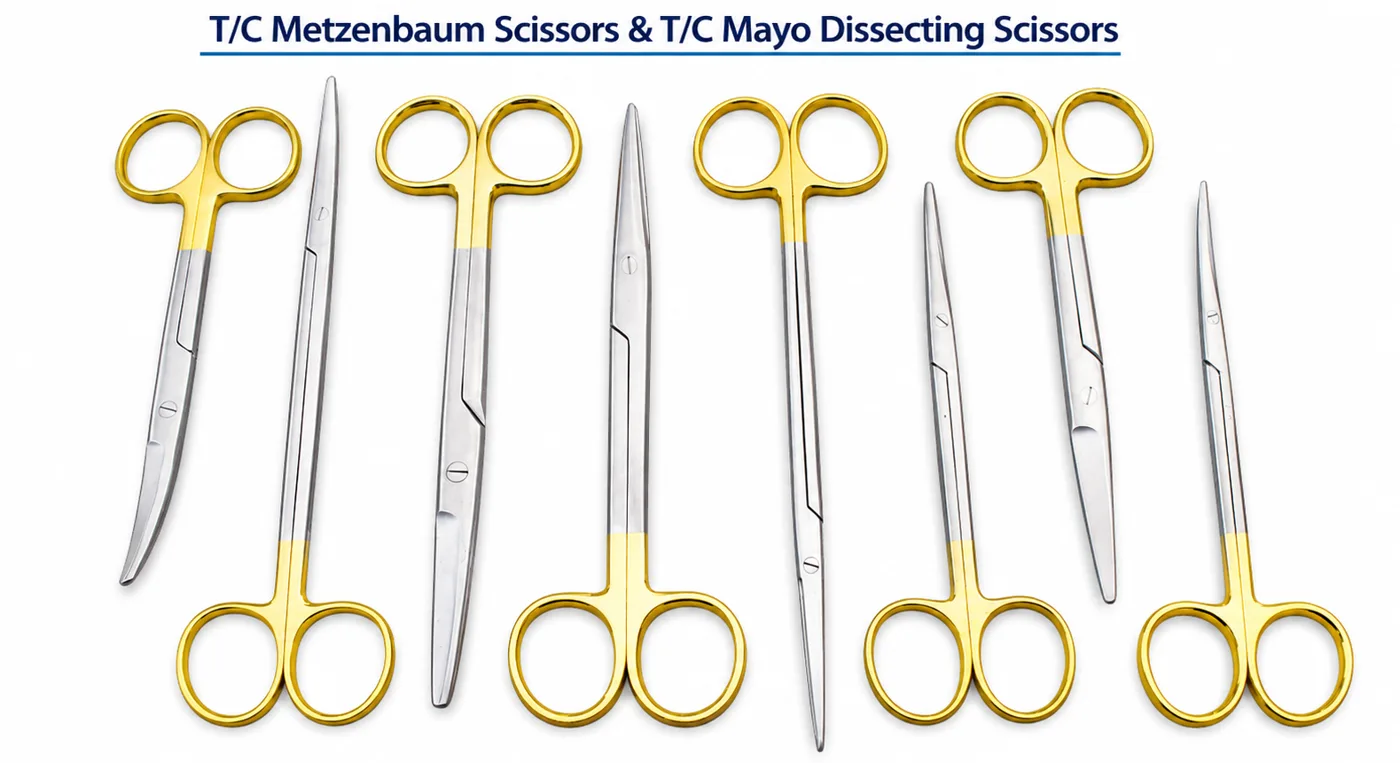
Metzenbaum vs Mayo scissors: the short answer
Metzenbaum scissors are for delicate tissue; Mayo scissors are for tough tissue. Metzenbaum scissors have long handles and comparatively short, thin, tapered blades with blunt tips, designed for fine dissection close to vessels and organs. Mayo scissors have shorter handles and thicker, heavier blades with wider blunt tips, built to cut dense structures such as fascia, muscle, tendon and sutures.
| Feature | Metzenbaum scissors | Mayo scissors |
|---|---|---|
| Main use | Fine dissection of soft, delicate tissue | Cutting heavy tissue, fascia and sutures |
| Blades | Thin, narrow, tapered | Thick, wide, robust |
| Handle-to-blade ratio | Long handles, short blades | Shorter handles, longer, heavier blades |
| Tips | Blunt, slim | Blunt, broad and rounded |
| Common sizes | 14.5, 18, 20, 23, 25 and 28 cm | 14.5, 17, 20 and 23 cm |
| Typical specialties | General, abdominal, thoracic, vascular, gynaecology, plastic surgery | General surgery, orthopaedics, obstetrics, veterinary surgery |
| Cut sutures? | No, it dulls the fine blades | Yes, straight Mayo is the classic suture scissors |
What are Metzenbaum scissors used for?
Metzenbaum scissors (often shortened to “Metz”) are named after the American surgeon Myron Firth Metzenbaum. Their long shanks let the surgeon work deep inside a body cavity while the short blades give precise control at the tip. Surgeons use them to:
- Separate tissue planes by blunt spreading as well as cutting
- Dissect around blood vessels, bowel, bladder and other delicate structures
- Undermine skin and soft tissue in plastic and reconstructive surgery
- Trim thin membranes and peritoneum during abdominal and gynaecological procedures
Curved Metzenbaum scissors are by far the most popular pattern because the curve improves visibility and follows natural tissue planes. Straight Metzenbaum scissors are preferred for superficial work and straight-line cuts. Well-known variations include the delicate Metzenbaum-Fino, the longer Metzenbaum-Nelson for thoracic surgery, and the Metzenbaum-Lipsett.
What are Mayo scissors used for?
Mayo scissors take their name from the Mayo Clinic surgeons who popularised them. They are the workhorse cutting instrument of general surgery and come in two classic forms:
- Straight Mayo scissors: used to cut sutures, drapes and dense tissue near the surface. On most trays these double as the scrub nurse’s suture scissors.
- Curved Mayo scissors: used to cut heavy tissue such as fascia, muscle, the uterus and tendons, especially deeper in the wound.
Related patterns include Mayo-Stille (heavier blades with a bevelled edge), Mayo-Harrington (longer, for deep surgery), Mayo-Noble and Mayo-Sims. Because Mayo scissors are robust, they are also standard in orthopaedic and large-animal veterinary sets.
T/C (tungsten carbide) vs standard stainless steel scissors
Both Metzenbaum and Mayo scissors are made in two grades. Standard scissors are made entirely of hardened martensitic stainless steel. T/C scissors have tungsten carbide inserts brazed onto the cutting edges, and their ring handles are plated gold so theatre staff can recognise them instantly on the tray.
- Sharper for longer: tungsten carbide is far harder than stainless steel, so the edge stays sharp through many more procedures.
- Cleaner cuts: a hard, precisely ground edge cuts tissue without chewing or pulling, which matters most in fine Metzenbaum dissection.
- Lower cost per use: T/C scissors cost more at purchase but need sharpening far less often, and the inserts can be reground or replaced.
- Easy identification: gold handles separate premium instruments from standard ones during sterile processing.
Read our detailed comparison of tungsten carbide vs stainless steel instruments to decide which grade suits your customers.
What about SuperCut scissors?
SuperCut scissors (often with black-coated handles) have one razor-sharp blade and one micro-serrated blade. The serrations hold tissue in place while the sharp blade cuts, so tissue does not slip out of the jaws. SuperCut Metzenbaum scissors are popular in plastic, cardiovascular and veterinary surgery. See our SuperCut Metzenbaum scissors.
How to choose the right size
Scissors length is chosen by the depth of the operating field, not the size of the patient:
- 14 to 15 cm (5.5 to 6 in): superficial and minor procedures, plastic surgery, small-animal veterinary work.
- 17 to 18 cm (7 in): the most common general surgery length for both Mayo and Metzenbaum.
- 20 to 23 cm (8 to 9 in): abdominal, pelvic and caesarean procedures.
- 25 to 28 cm (10 to 11 in): deep abdominal, thoracic and bariatric surgery (mainly Metzenbaum and Mayo-Harrington).
Distributors usually stock curved Metzenbaum in 14.5, 18 and 23 cm, and straight and curved Mayo in 14.5 and 17 cm, as these sizes appear on most surgical instrument set lists.
Quality checks before you buy
- Cutting test: good scissors cut cleanly through wet gauze or a thin latex sheet along the full blade, right to the tip, without catching.
- Smooth action: the blades should open and close evenly with no grinding, play or stiffness at the joint screw.
- Tip alignment: closed tips should meet exactly, with no crossing or gap.
- Insert finish: on T/C scissors the carbide inserts should be flush, evenly brazed and free of chips.
- Passivation and finish: a uniform satin or mirror finish without pits or stains shows correct passivation and corrosion resistance.
Our guide on how to check the quality of surgical instruments covers these tests step by step.
Care tips that keep scissors sharp
- Never use Metzenbaum scissors to cut sutures, wire or drapes; keep a straight Mayo for that.
- Clean immediately after use and open the joint so blood cannot dry in the box area.
- Lubricate the joint with instrument milk before sterilisation.
- Store and sterilise with tips protected, and never throw scissors loosely into a basin.
- Send T/C scissors for professional resharpening rather than grinding them in-house.
Follow our full cleaning and sterilisation guide for more detail.
T/C Metzenbaum and Mayo scissors from Pak Line
Pak Line Industries manufactures standard, T/C and SuperCut dissecting scissors in Sialkot, Pakistan, in straight and curved patterns from 11.5 cm to 28 cm. We supply hospitals, distributors and veterinary wholesalers in more than 55 countries, with OEM and private-label options including your brand laser-etched on every instrument. Browse our T/C Metzenbaum scissors, Mayo dissecting scissors, the full surgical scissors range, or read our overview of types of surgical scissors.
Order T/C Metzenbaum & Mayo scissors direct from the factory
Pak Line Industries has manufactured surgical, dental and beauty instruments in Sialkot, Pakistan since 1985. ISO 13485 & CE quality, OEM and private label, exported to 55 countries.
FAQs
What is the difference between Metzenbaum and Mayo scissors?
Metzenbaum scissors have long handles and thin, short blades for delicate tissue dissection. Mayo scissors have shorter handles and heavier blades for cutting tough tissue such as fascia, muscle and sutures.
Can you cut sutures with Metzenbaum scissors?
No. Cutting sutures dulls and misaligns the fine blades of Metzenbaum scissors. Use straight Mayo scissors or dedicated suture scissors instead.
What does T/C mean on surgical scissors?
T/C stands for tungsten carbide. T/C scissors have tungsten carbide inserts on the cutting edges and gold-plated handles, so they stay sharp much longer than standard stainless steel scissors.
Why are some surgical scissors curved?
Curved blades improve the surgeon’s view of the tips and follow natural tissue planes, which makes curved scissors better for dissection deeper in the wound.
What size Metzenbaum scissors are most common?
Curved Metzenbaum scissors in 14.5 cm, 18 cm and 23 cm are the most commonly ordered sizes for general and abdominal surgery sets.
Can tungsten carbide scissors be resharpened?
Yes. T/C scissors can be professionally reground, and worn inserts can be replaced, which extends their working life considerably.
