

Adson forceps are among the most frequently ordered instruments in any surgical catalogue. They appear on minor surgery, plastic surgery, dermatology, dental and veterinary trays, and almost every set contains at least two pairs: one with teeth and one without teeth. The two look almost identical from a distance, yet they do very different jobs. This guide explains the difference between toothed and smooth Adson forceps, when each is used, the common variations and sizes, and what buyers should specify when ordering.
What are Adson forceps?
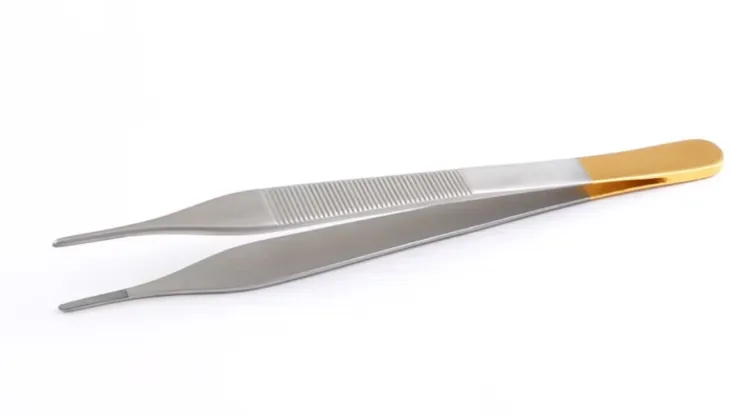
Adson forceps are spring-action thumb forceps (tweezers) with a broad, flat handle that narrows sharply into a fine working tip. They are named after the American neurosurgeon Alfred Washington Adson. The wide handle gives the surgeon a comfortable, stable grip, while the narrow tip allows delicate, precise handling of small amounts of tissue. A standard Adson forceps is about 12 cm (4.75 in) long, which makes it ideal for superficial work such as skin closure.
Adson forceps with teeth vs without teeth: the short answer
Toothed Adson forceps grip tissue; smooth Adson forceps handle dressings and delicate structures. Teeth give a secure hold on tough, slippery tissue such as skin, so it does not slip while suturing. Smooth or serrated tips spread the pressure over a wider area and are used where teeth would tear or puncture.
| Feature | Adson with teeth (tissue forceps) | Adson without teeth (dressing forceps) |
|---|---|---|
| Tip pattern | 1×2 interlocking teeth (one tooth fits between two) | Smooth, or fine cross-serrations |
| Grip | Firm, secure, minimal slipping | Gentle, spreads pressure |
| Main uses | Holding skin edges during suturing, handling fascia and dense tissue | Dressings, gauze and packing, suture removal, delicate tissue and vessels |
| Tissue trauma | Small, localised puncture points | Low on dressings, but can crush if squeezed hard on tissue |
| Also called | Adson tissue forceps, Adson 1×2 | Adson dressing forceps, Adson serrated |
Adson tissue forceps (with teeth)
The classic toothed pattern is 1×2 teeth: one tooth on one tip closes between two teeth on the opposite tip. This interlocking design grips skin securely with very little pressure, which is why surgeons often find toothed forceps less traumatic for skin than squeezing hard with smooth ones. Typical uses include:
- Everting skin edges while placing sutures
- Holding fascia, subcutaneous tissue and dense connective tissue
- Minor procedures such as cyst and lipoma excision, biopsies and wound repair
- Oral surgery flaps and veterinary skin closure
Toothed forceps should not be used on bowel, blood vessels or other delicate structures, where the teeth can perforate tissue.
Adson dressing forceps (without teeth)
Adson dressing forceps have smooth tips or, more often, fine transverse serrations on the inner surfaces. Serrations improve grip without the puncture points of teeth. They are used to:
- Place and remove dressings, gauze and packing
- Hold sutures and remove stitches
- Handle delicate tissue, small vessels and nerves
- Pick up and pass small items on the sterile field
Buyer note: “smooth” and “serrated” are not always interchangeable. When ordering, state the exact tip (smooth, serrated or 1×2 teeth) rather than relying only on the product name.
Common Adson variations
- Adson-Brown forceps: 7×7 or 9×9 rows of fine, delicate teeth on each tip. They grip with very little pressure and are popular in plastic surgery.
- Micro-Adson forceps: extra-fine tips for delicate plastic, hand and facial surgery.
- Adson forceps with tying platform: a small flat area behind the tip for instrument-tying sutures.
- Bayonet Adson forceps: angled shaft to keep the hand out of the line of sight in neurosurgery and ENT work.
- Tungsten carbide (TC) Adson forceps: hard carbide tip inserts with gold handles for longer-lasting, more precise grip.
Do not confuse Adson thumb forceps with the Adson hemostatic forceps, which is a ringed clamp, or the Adson suction tube. See our guide to types of surgical forceps for a wider comparison.
Sizes and specifications to state on an order
- Length: 12 cm (4.75 in) is standard; 15 cm and longer versions are available for deeper work.
- Tip type: 1×2 teeth, Brown teeth, smooth or serrated.
- Tip width: standard, delicate or micro.
- Tying platform: with or without.
- Finish: satin (anti-glare) or mirror polish.
- Grade: standard stainless steel or tungsten carbide inserts.
- Marking and packing: laser-etched brand, pattern number and packaging for private label.
Quality checks for Adson forceps
- Tip alignment: when closed, the tips should meet exactly, with no crossing or overlap.
- Teeth mesh: on 1×2 forceps the single tooth must sit cleanly between the two opposing teeth without catching.
- Spring tension: the forceps should open fully and close smoothly with even, comfortable tension.
- Serrations: clean, even and burr-free, so they grip without snagging gauze or tissue.
- Finish and passivation: uniform surface without pits or stains, showing good corrosion resistance.
For a full checklist, read how to check the quality of surgical instruments.
Adson forceps from Pak Line
Pak Line Industries manufactures Adson tissue forceps, Adson dressing forceps, Adson-Brown, micro-Adson and TC Adson patterns in Sialkot, Pakistan, for distributors, hospitals and private-label brands in more than 55 countries. Browse Adson forceps 1×2, Adson tissue forceps, mini-Adson forceps, or our full general surgery instruments range. Adson forceps are standard items in every minor surgery set.
Order Adson forceps direct from the manufacturer
Pak Line Industries has manufactured surgical, dental and beauty instruments in Sialkot, Pakistan since 1985. ISO 13485 & CE quality, OEM and private label, exported to 55 countries.
FAQs
What is the difference between Adson forceps with teeth and without teeth?
Adson forceps with teeth have 1×2 interlocking teeth for a secure grip on skin and dense tissue. Adson forceps without teeth have smooth or serrated tips for dressings, sutures and delicate tissue.
What are Adson forceps with teeth used for?
They are mainly used to hold and evert skin edges during suturing and to handle fascia and other tough tissue in minor, plastic, dental and veterinary surgery.
What does 1×2 teeth mean?
1×2 means one tooth on one tip closes between two teeth on the opposite tip, giving a firm interlocking grip.
What size are standard Adson forceps?
Standard Adson forceps are 12 cm (4.75 inches) long. Longer 15 cm versions and finer micro patterns are also made.
What is the difference between Adson and Adson-Brown forceps?
Adson-Brown forceps have multiple rows of very fine teeth (usually 7×7 or 9×9) instead of 1×2 teeth, which grip delicate tissue with less pressure.
Are smooth and serrated Adson forceps the same?
Not always. Smooth tips have no pattern, while serrated tips have fine grooves for extra grip. Buyers should specify the exact tip when ordering.
