

A laryngoscope is one of the most important instruments on any anaesthesia trolley, emergency cart or ambulance. It lets clinicians see the vocal cords and place an endotracheal tube safely during airway management. For hospitals, distributors and tender buyers, choosing laryngoscopes means more than picking a blade shape: handle compatibility, illumination type, blade sizes, materials and reprocessing all decide whether the set will perform reliably for years. This guide explains the main laryngoscope blade types, sizes, conventional vs fibre-optic systems, and the quality checks buyers should make.
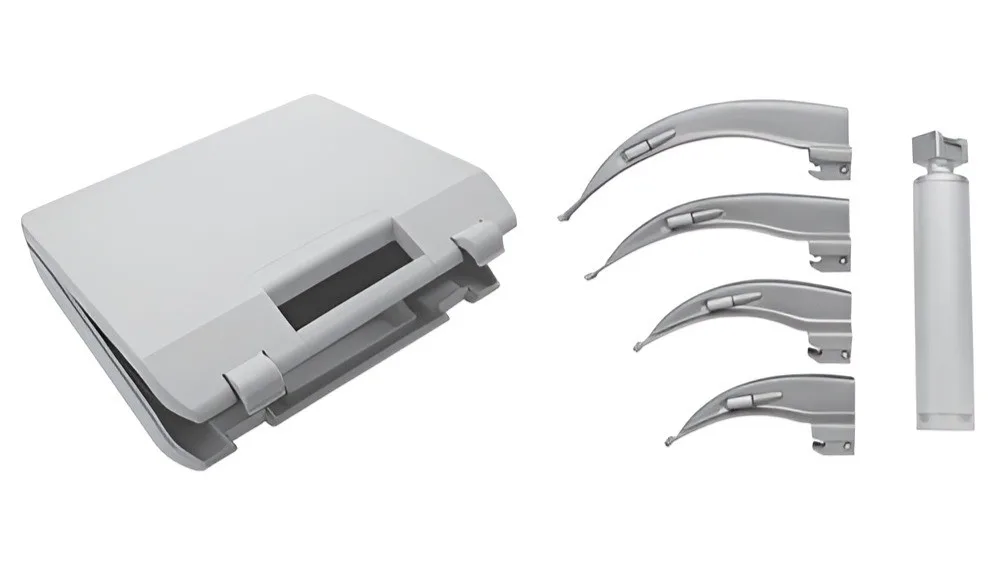
Parts of a laryngoscope
- Handle: holds the batteries (or a rechargeable cell) and, in fibre-optic systems, the light source. Handles come in standard, medium, small (paediatric) and stubby sizes.
- Blade: lifts the tongue and epiglottis to expose the larynx. Blades are interchangeable and click onto the handle with a hook-on fitting.
- Light source: either a small bulb on the blade (conventional) or a bulb/LED in the handle that transmits light through a fibre-optic bundle in the blade.
Laryngoscope blade types
| Blade | Shape | How it works | Typical sizes |
|---|---|---|---|
| Macintosh | Curved | Tip sits in the vallecula and lifts the epiglottis indirectly. The most widely used adult blade. | 0, 1, 2, 3, 4, 5 |
| Miller | Straight | Tip lifts the epiglottis directly. Popular in paediatrics and for anterior airways. | 00, 0, 1, 2, 3, 4 |
| Wisconsin | Straight, wider flange | Wider profile helps control the tongue; used in adults and children. | 0, 1, 2, 3, 4 |
| McCoy | Curved with hinged tip | A lever on the handle end flexes the tip to lift the epiglottis further in difficult airways. | 3, 4 |
| Robertshaw | Straight with gentle curve | Designed mainly for infants and small children. | 0, 1 |
Curved vs straight: curved blades (Macintosh) are generally preferred in adults because they give more room to pass the tube. Straight blades (Miller, Wisconsin, Robertshaw) are often chosen for neonates, infants and patients with a floppy or long epiglottis. Most hospitals stock both.
Which blade size to choose
- Miller 00 and 0: premature babies and neonates
- Miller 1 / Mac 1: infants
- Mac 2 / Miller 2: children
- Mac 3: most adults (the standard adult blade)
- Mac 4: larger adults
- Mac 5: very large adults
Size selection is always a clinical decision. For purchasing, most hospitals order adult sets (Mac 2, 3, 4 with a handle) and paediatric sets (Miller 0, 1, 2 with a small handle).
Conventional vs fibre-optic laryngoscopes
| Conventional | Fibre-optic | |
|---|---|---|
| Light source | Small bulb screwed into the blade | Bulb or LED in the handle; light travels through a fibre bundle in the blade |
| Blade cleaning | Bulb must be removed or protected | No electrical parts in the blade, easier to clean and autoclave |
| Light quality | Can dim as the bulb ages or loosens | Brighter, more consistent, often whiter with LED |
| Compatibility | Conventional blades fit conventional handles | Fibre-optic (“green system”) blades fit matching fibre-optic handles |
| Cost | Lower | Higher, but longer life and easier reprocessing |
Important: conventional and fibre-optic blades and handles are not interchangeable. Fibre-optic systems built to the ISO 7376 “green” specification are usually marked with a green ring so staff can match blades and handles. Always confirm which system your customer uses before ordering spare blades.
Quality checks for laryngoscopes
- Materials: blades in medical-grade stainless steel with a smooth, corrosion-resistant finish; handles in chrome-plated brass, stainless steel or aluminium with a knurled grip.
- Hook-on fitting: the blade should click firmly onto the handle, lock in the open position and switch the light on reliably every time.
- Illumination: bright, even light at the blade tip; on fibre-optic blades the bundle should be intact with no dark spots.
- Edges and finish: no sharp edges, burrs or rough welds that could injure teeth or soft tissue.
- McCoy hinge: smooth lever action with the tip returning fully to neutral.
- Documentation: clear cleaning and sterilisation instructions and material information for regulatory files.
Common problems and how to avoid them
- Light fails or flickers: check batteries, bulb tightness and the contact between blade and handle; clean contacts regularly.
- Loose blade connection: worn hook-on pins or springs; inspect and replace worn parts.
- Damaged fibre bundle: avoid dropping blades and harsh chemicals that cloud the fibres.
- Corrosion and staining: clean promptly after use and dry completely before storage.
Cleaning and reprocessing
Laryngoscope blades contact mucous membranes and must be cleaned and then high-level disinfected or sterilised after every patient, following the manufacturer’s validated instructions. Remove batteries before reprocessing the handle, never immerse a conventional handle, and inspect every blade and handle before returning it to the trolley. See our instrument cleaning and sterilisation guide.
Laryngoscopes from Pak Line
Pak Line Industries supplies reusable conventional and fibre-optic laryngoscope sets, handles and blades (Macintosh, Miller and other patterns) from Sialkot, Pakistan for distributors, hospitals and government tenders in more than 55 countries. Browse the Macintosh laryngoscope set with 4 blades, the Miller laryngoscope set, laryngoscope handles, our anaesthesia instruments, or request samples.
Source laryngoscope sets direct from the manufacturer
Pak Line Industries has manufactured surgical, dental and beauty instruments in Sialkot, Pakistan since 1985. ISO 13485 & CE quality, OEM and private label, exported to 55 countries.
FAQs
What is the difference between Macintosh and Miller blades?
A Macintosh blade is curved and its tip sits in the vallecula to lift the epiglottis indirectly. A Miller blade is straight and lifts the epiglottis directly.
What size laryngoscope blade is used for adults?
A Macintosh 3 is the standard adult blade, with a Macintosh 4 for larger adults.
What is a fibre-optic laryngoscope?
A fibre-optic laryngoscope has the light source in the handle and carries the light to the blade tip through a fibre-optic bundle, giving brighter light and easier blade cleaning.
Are conventional and fibre-optic blades interchangeable?
No. Conventional blades fit conventional handles and fibre-optic blades fit matching fibre-optic (green system) handles.
What is a McCoy blade used for?
A McCoy blade has a hinged tip that can be raised with a lever to lift the epiglottis further, which can help in difficult airways.
How should laryngoscope blades be cleaned?
Blades should be cleaned and then high-level disinfected or sterilised after every patient, following the manufacturer’s validated instructions.
