


The needle holder is one of the most frequently used instruments in surgery and dentistry. It clamps a curved suture needle firmly so the surgeon can drive it through tissue with control. Choosing the wrong pattern or size leads to needle rotation, bent needles and tired hands. This guide explains the main needle holder types and how to choose.
Anatomy of a needle holder
- Jaws: short and strong, with fine serrations or a cross-hatched tungsten carbide insert to grip the needle.
- Box lock: the joint, which must be tight and smooth.
- Ratchet: locks the jaws on the needle at different pressures.
- Finger rings or spring handles: ring handles for general surgery, spring handles for micro work.
Common needle holder patterns
- Mayo-Hegar: the general surgery standard, available from about 14 to 25 cm, used with medium to large needles.
- Webster: short and delicate with smooth or fine jaws, ideal for small needles in plastic surgery and dermatology.
- Crile-Wood: slender jaws for fine to medium needles in general and vascular surgery.
- Olsen-Hegar: combines a needle holder and suture scissors in one instrument, popular in dental and veterinary practice.
- Mathieu: spring handle with a ratchet that releases on further squeezing, used in dentistry and orthopedics.
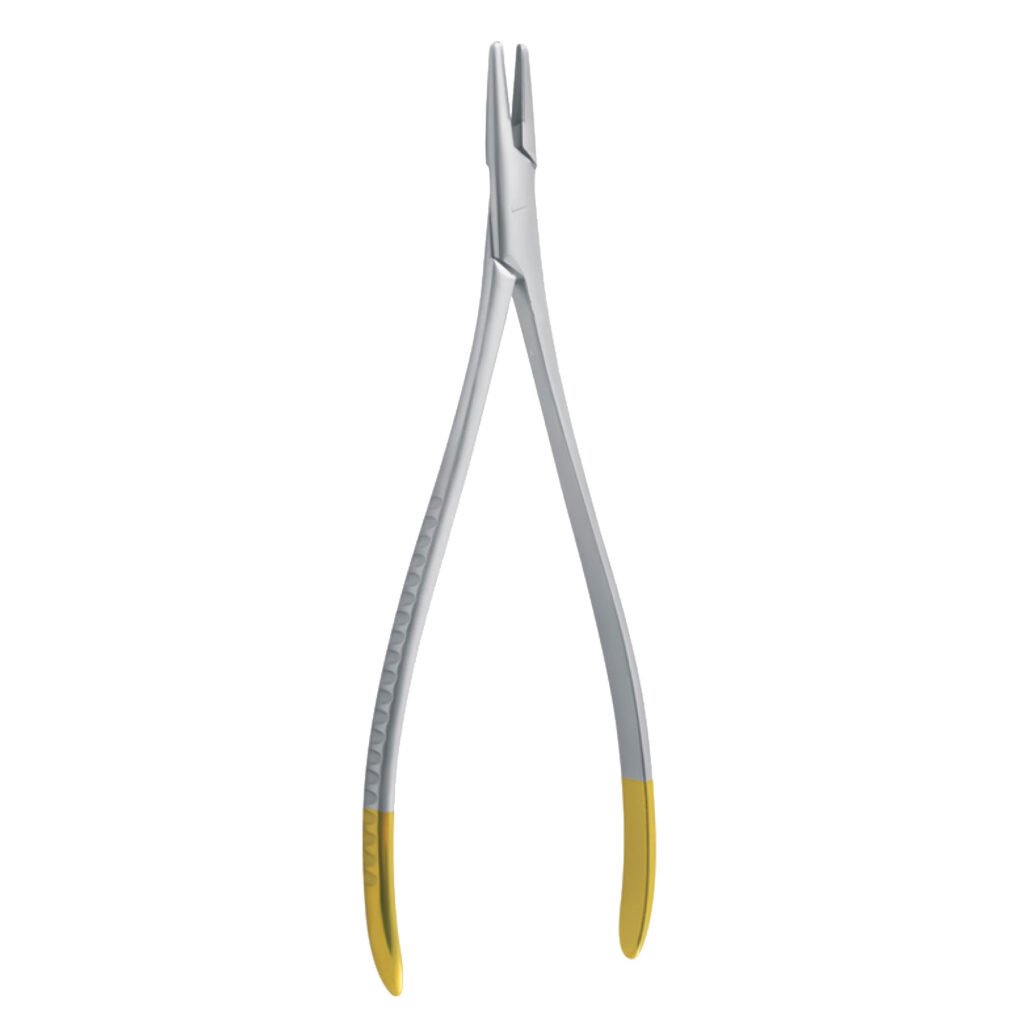
- Castroviejo: spring-handled micro needle holder for ophthalmic, micro and periodontal surgery, with or without lock.
- DeBakey and Ryder: fine patterns for cardiovascular and delicate suturing.
Choosing the right size
Match the length to the depth of the wound and the jaw to the needle. Short holders (12 to 14 cm) suit superficial and dental work; medium (16 to 18 cm) suit most general surgery; long (20 cm and above) are for deep abdominal or pelvic work. Fine needles need narrow, smooth or finely serrated jaws, while large needles need wide, strong jaws.
Stainless steel vs tungsten carbide jaws
Tungsten carbide (TC) needle holders, recognisable by gold handles, have replaceable inserts with a precise cross-cut pattern that grips needles without slipping and lasts much longer than standard serrations. They are the preferred choice for busy theatres and clinics. Read our full comparison of tungsten carbide vs stainless steel instruments.
Quality checks
- Jaws close fully from tip to heel with no light visible.
- Needle does not rotate when locked on the first ratchet tooth.
- Ratchet engages and releases smoothly.
- No play in the box lock.
Care tips
Do not use needle holders to clamp tissue or wire, keep the ratchet open during sterilisation and lubricate the joint regularly. See our cleaning and sterilisation guide.
Pak Line Industries manufactures Mayo-Hegar, Webster, Crile-Wood, Olsen-Hegar, Mathieu and Castroviejo needle holders in stainless steel and tungsten carbide. Browse surgical instruments and implant instruments.
FAQs
What is the most common needle holder?
The Mayo-Hegar needle holder is the most widely used pattern in general surgery.
Which needle holder has scissors built in?
The Olsen-Hegar needle holder combines a needle holder and suture scissors.
Source instruments direct from the manufacturer
Pak Line Industries has manufactured surgical, dental and beauty instruments in Sialkot, Pakistan since 1985. ISO 13485 & CE quality, OEM and private label, exported to 55 countries.
