


Orthodontic treatment relies on a set of specialised hand instruments, and orthodontic pliers are at the heart of it. Each plier is designed for a specific job: bending archwires, cutting ligatures, placing bands or removing brackets. This guide covers the main types of orthodontic pliers, their names and uses, and what to look for in quality instruments.
1. Wire bending pliers
- Bird beak plier (No. 139): one round and one pyramidal beak, used for bending loops and springs in round wire.
- Three-jaw (Aderer) plier: forms precise bends in light wires and clasps.
- Tweed loop and arch forming pliers: create loops and contour rectangular archwires.
- Light wire (Angle) plier: general bending of light round wires.
- Adams plier: bending and adjusting Adams clasps and removable appliance wires.
2. Placement and adjustment pliers
- Weingart utility plier: serrated, tapered tips for placing and removing archwires. One of the most used pliers in any practice.
- How plier (straight and angled): holds and places wires and ligatures, and seats bands.
- Mathieu needle holder style plier: places elastic and wire ligatures.
- Distal bender: bends the distal end of an archwire behind the last tube.
3. Cutting pliers
- Distal end cutter: safely cuts and holds the distal end of the archwire inside the mouth.
- Ligature cutter: fine tips to cut steel ligature ties close to the bracket.
- Hard wire cutter: cuts heavy stainless steel wires, usually outside the mouth.
- Pin and ligature cutter: trims pins and ligatures in tight spaces.
Cutters often have tungsten carbide inserts for long-lasting, clean cuts.
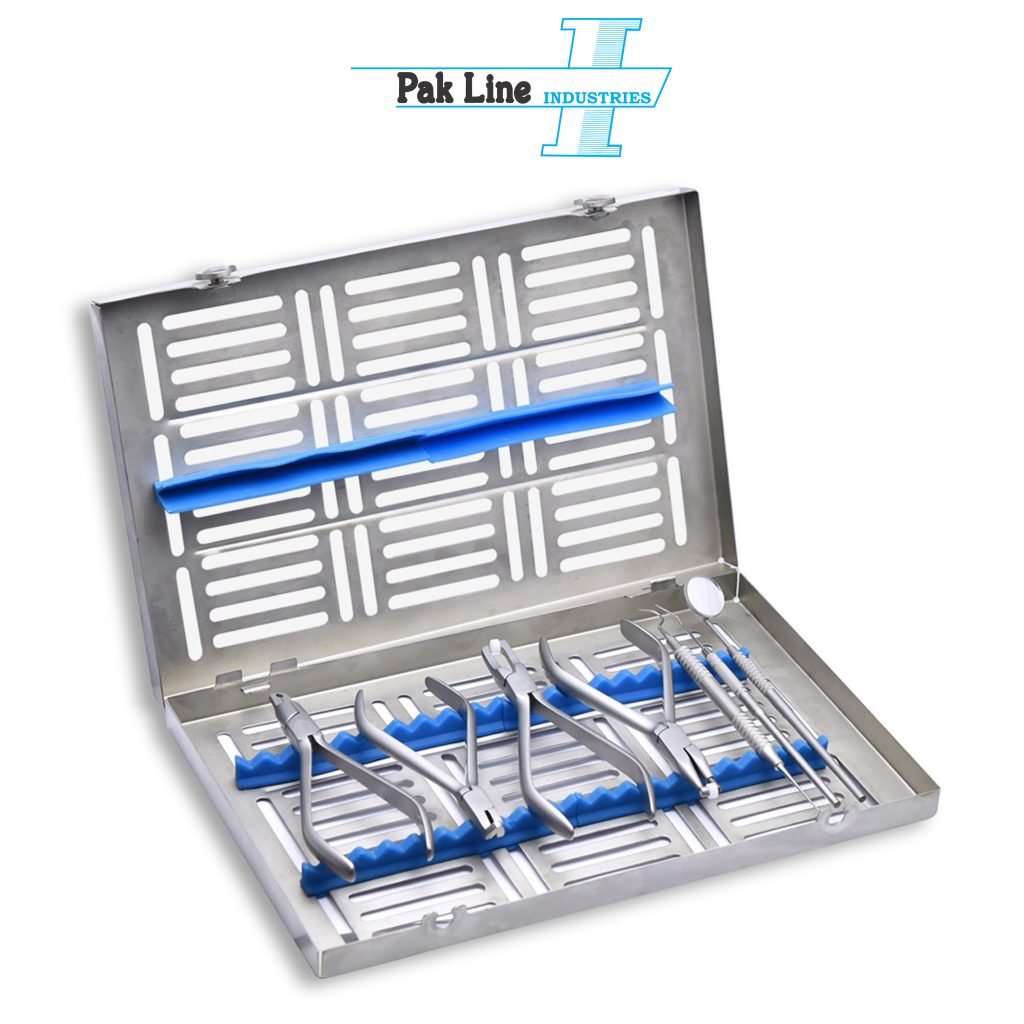
4. Band and bracket pliers
- Band removing plier: removes molar bands with a protective pad on the occlusal surface.
- Band seater and pusher: adapts and seats bands on molars.
- Bracket removing (debonding) plier: removes brackets with minimal enamel stress.
- Bracket holding tweezers: position brackets accurately during bonding.
5. Other orthodontic instruments
A complete kit also includes elastic placers, ligature directors, band pushers, scalers for cement removal, and mouth mirrors and probes. Ready-made orthodontic sets make it easy to equip a new clinic.
What to look for in orthodontic pliers
- Precise tip alignment so wires are bent accurately.
- Smooth, tight box joints with no lateral play.
- Hardened tips or TC inserts for cutters.
- Autoclave-safe finish and good corrosion resistance.
- Comfortable, balanced handles for long clinical sessions.
Orthodontic pliers from Pak Line Industries
We manufacture orthodontic pliers, cutters and complete orthodontic kits in Sialkot for orthodontists, dental schools and distributors worldwide. Browse our orthodontic instruments and instrument sets, or ask for a private label quote.
FAQs
Which plier is used to place and remove archwires?
The Weingart utility plier is most commonly used to place and remove archwires.
What is a distal end cutter used for?
It cuts the end of the archwire behind the last molar tube and holds the cut piece so it does not fall into the mouth.
Source instruments direct from the manufacturer
Pak Line Industries has manufactured surgical, dental and beauty instruments in Sialkot, Pakistan since 1985. ISO 13485 & CE quality, OEM and private label, exported to 55 countries.
