


Hemostatic forceps, often called hemostats or artery forceps, clamp blood vessels and tissue to control bleeding. They look similar at first glance, but differences in size, jaw serration and teeth make each pattern suited to a specific job. Here is how to tell the common types apart.
How hemostats are designed
All hemostats have ring handles, a box lock and a ratchet that keeps the jaws locked. The differences are in the jaws:
- Serrations: transverse serrations along part or all of the jaw.
- Teeth: some patterns have 1×2 interlocking teeth at the tip for a firm grip on tough tissue.
- Shape: straight or curved, fine or heavy.
Common hemostatic forceps
- Mosquito (Halsted): small, fine jaws, about 12.5 cm, for small vessels and delicate work.
- Kelly: medium size, about 14 cm, serrations on the distal half of the jaw only.
- Crile: same size as Kelly but with serrations along the full jaw length.
- Rochester-Pean: larger, about 16 to 24 cm, fully serrated, for large vessels and tissue bundles.
- Kocher (Ochsner): fully serrated with 1×2 teeth at the tip, for grasping tough tissue such as fascia.
- Mixter and right-angle forceps: 90-degree jaws for passing ligatures around vessels.
- Adson / Baby Mixter: fine right-angled patterns for delicate dissection.
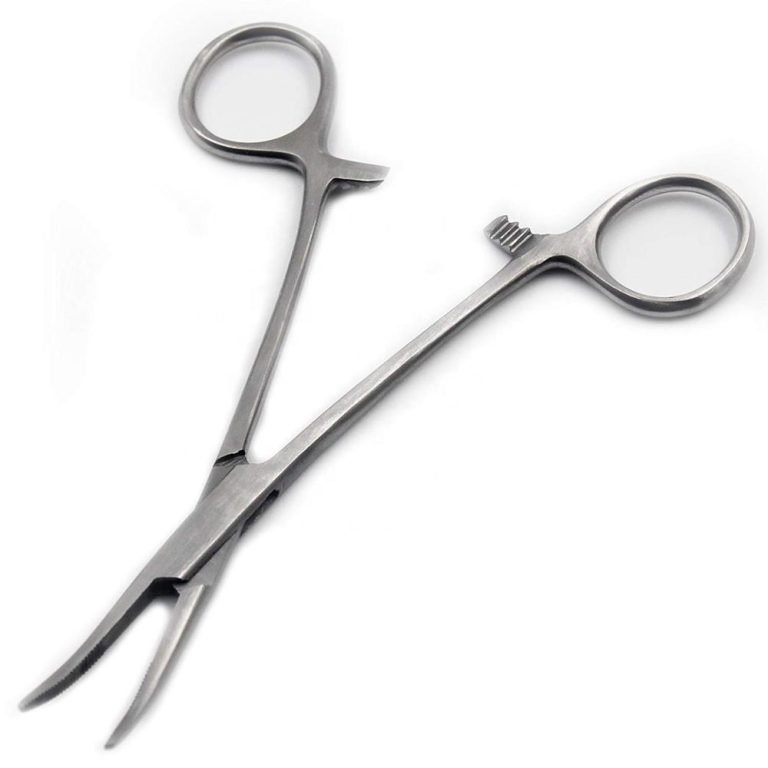
Kelly vs Crile: the easy way to remember
Both are the same length, but Kelly forceps are serrated only on the front half of the jaw, while Crile forceps are serrated all the way to the box lock. A common memory aid: “Crile is complete”.
Quality points
- Jaws meet evenly with no gaps
- Ratchet holds securely on each tooth and releases smoothly
- Box lock is tight with no lateral movement
- Serrations are sharp and clean without burrs
Hemostats are often supplied with needle holders and scissors as part of basic surgical sets. Pak Line Industries manufactures all major hemostat patterns in Sialkot. Browse surgical instruments or instrument sets.
FAQs
What is the smallest hemostat?
The mosquito (Halsted) forceps is the smallest common hemostat, used for small vessels.
Which hemostat has teeth?
Kocher (Ochsner) forceps have 1×2 teeth at the tip for a secure grip on tough tissue.
Source instruments direct from the manufacturer
Pak Line Industries has manufactured surgical, dental and beauty instruments in Sialkot, Pakistan since 1985. ISO 13485 & CE quality, OEM and private label, exported to 55 countries.
